
NO. 03 · SAVOY CABBAGE CAKE
Sculptural Cakes
Dressed by hand, around a taste kept out of sight.
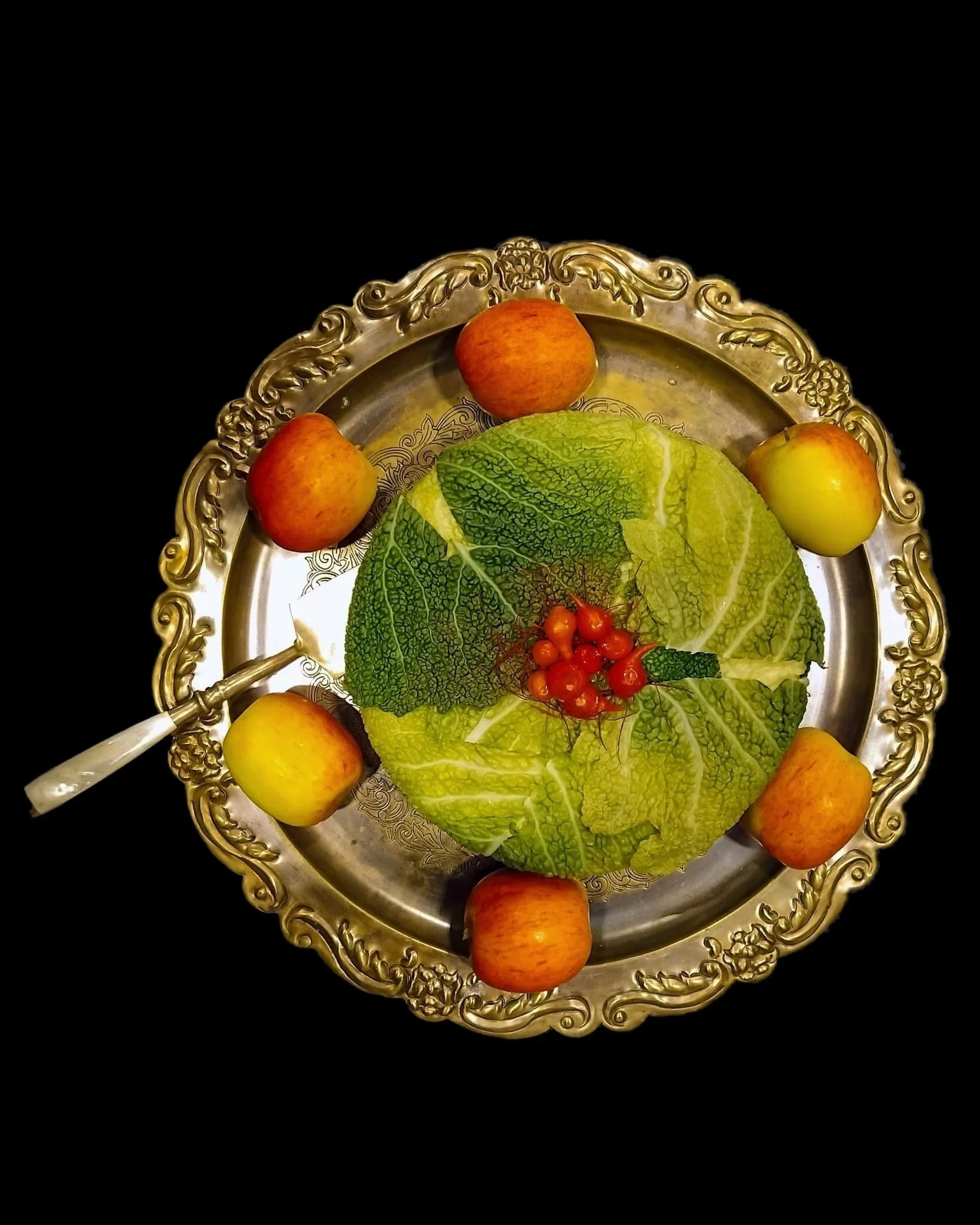
Of all the sculptural cakes held in the Veceto Archive, Savoy Cabbage Cake alone is dressed rather than built. Its form is settled first and left plain, so that whatever follows becomes a question of surface. Each sheet goes on by hand, drawn taut and smoothed flat against the volume like cloth cut to measure. Nothing is pressed or forced; every fold is coaxed out before the next layer follows. Fit replaces ornament; nothing is laid on top. Savoy arrives already quilted, its ribs and puckers closer to a woven ground than to anything that simply grew. Edible textiles share their vocabulary with tailoring: drape, tension, the line where panel meets panel. Dressing a cake asks for that same attention and spends it on something that will not keep.
I · DRESSED
Cake is the one sculpture made to be cut. Most sculptural cakes are carved down into their outline, while this one keeps its outline and receives a skin instead. Built with the knife in mind, the cover answers to the blade as much as to the eye. Any slice would carry leaf above and leaf below, the cladding intact through every piece. Where the joins fall along the curve, the green does not quite match, and the seam remains in view. No two folds behave alike, so each edge is set without a template. Vegetal Cladding holds its precision at the edge and lets the tone drift as it will. Correction would erase the hand, so none is attempted.
II · SEAM
Under the leaves sits a taste finished with the same care as the outside, and none of it shows. Read as material exploration, sculptural cakes pose a narrow question. How much form can a soft, pliant skin hold while staying something to eat? For Veceto, a food design studio, the taste of a piece is weighed as closely as its look. Flavour cannot be photographed, so it enters the record only as a fact. Withholding is a choice of address: the surface speaks to whoever looks, the interior to whoever eats. As a multisensory object, it stays half told.
III · BENEATH
IV · CENTRE
Set at the centre of a room, among many things placed with equal care, it draws people back before anything else. All else on display is arranged around it, in a single key. They come close, step back, then come close again. From a distance it reads as a sealed volume; near, the seams appear, and with them the trace of fingers. Even its setting repeats the space in miniature. At the rim, the green of the leaves and the red of the heart reappear; the eye travels outward and returns. Brass and nacre outlast everything they are asked to carry. Beside it, the server lies ready and is never lifted. Without any immersive staging, the space turns in its direction. Among the edible art creations kept in the Archive, it is shown as it left the room: closed. Nearby, an ephemeral sculpture of bread stands upright against the dark. Everything on the tray is made to be eaten, the cover included.
Commissions begin with a reading of the brand, long before the first form.