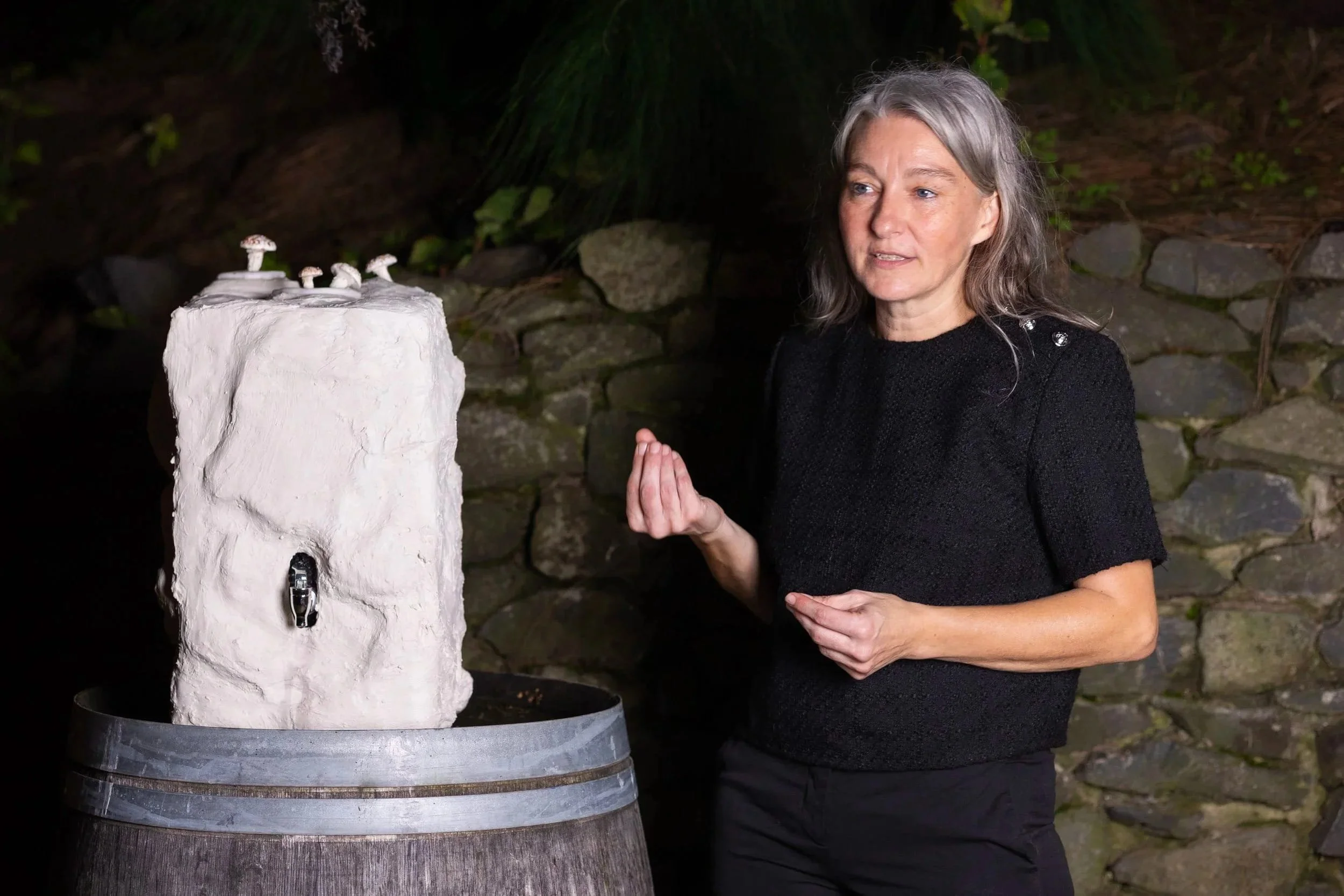
KERSTIN PRICKEN · CULINARY ARTIST
Artistic Director of VECETO
Kerstin Pricken became a culinary artist by way of the sculptor's materials. Raised in Germany, she cut, drilled, ground and polished stone, wood and metal; silk, pigment and ceramic came after. Each was handled for its effect on the senses: weight in a palm, coolness, give under the thumb. Silk taught patience; ceramic, humility.
Ten years of Nordic design followed: furniture, textiles, high-end interiors, rooms composed for print. Creative direction began there, as the habit of lighting an arrangement and then removing one more thing.
Gastronomy arrived last, on her own terms. Freed from the rigid doctrines of classical gastronomy, she trained her own palate. Experiment followed experiment, each watched to its end. Veceto opened in 2024 in New Zealand; installations travel to wherever they are meant to be seen.
Sometimes the concept comes first; flavour and colour are then found for it. Season and origin decide what reaches her kitchen. Ingredients are chosen for where they grew and when, then studied like a material. Oil, at a certain moment, stops being an ingredient and becomes surface. Such thresholds are learned slowly, over many harvests, by a culinary artist who trusts her hands before any recipe.
For a culinary artist, texture carries as much as flavour. Crisp sits beside yielding, matte against glaze, warm beside cool. In the mouth, surfaces are read as closely as fingers once knew polished stone and wood. Contrasts are placed with care, so that one bite holds several moments.
Food sculpture artists share her medium; her own path to it led past the polishing wheel. Where a concept calls for an object, she knows which material should carry it, and why. She makes such pieces herself as readily as she directs them; concrete cast by hand and lit from within was one. When another discipline serves the idea better, she knows which atelier to rely on, and what to ask of it.
Made for Its Hour: Experiential Design
Edible work completes itself within one evening, and it begins to change from the first minute. Cream softens, salt draws moisture, sugar answers the air of a room. Temperature and timing belong to the composition as fully as form does. Every element is finished for the moment it will be met.
Light decides the rest. Colours are judged under the light they belong to, usually dusk or candles. Daylight in the studio tells little. Read across a hall, an arrangement shows its outline; detail arrives with the approach.
Experiential design, for a contemporary artist working with the edible, runs from an opening sketch to an emptied plinth. Sensory Excavation is her name for how a piece unfolds: layers uncovered in sequence, each found rather than presented. Certain works are immersive, enclosing a visitor in a complete environment. Others gather into one tableau that rewards a closer approach. Several become multisensory, a projected ocean moving behind them.
Down to the last fleck of pigment, every component can be eaten and is meant to be. To a conceptual food artist schooled in sculpture, ornament for its own sake held little appeal.
CONTINUUM, her essay series on food design, watches the everyday turn strange and the strange become everyday, in fashion, architecture and art. Entries come like letters from the studio. Some begin with one object; others with a season, a fair or a fabric.
Fifteen years of making and composing sit behind each installation. One judgement connects them: deciding when a composition may leave the kitchen. It remains, for a culinary artist who began with her hands, the instrument she trusts most.
Nothing sits where it ordinarily would. None of it lasts the evening.
Between a letter and an opening line, each commission is given its time.