Casting as Thinking
CONTINUUM No. 003
Absence in casting has to be designed before presence can be perceived. Food design rarely proceeds that way. Work gets planned as though what matters is what will finally be there, and material corrects that assumption within a single afternoon.
Voids arrive first, imagined whole, pressed into damp sand that accepts an impression once and refuses a second. Concrete follows, obedient and indifferent and permanent.
Objects here are made rather than bought. Anything reaching a table was cast for that table and for nothing else, which removes the catalogue from the process and removes the plate as a default surface. Serving onto porcelain means working forward from what already exists, while casting works backwards from what a piece requires. Containers become part of the argument instead of neutral ground beneath it, which is where food design separates from arrangement.
Ordinary practice runs the other way. Composition begins with what will occupy a surface, a room, a table, and emptiness becomes whatever remains once the additions stop. Reversal of that habit is not a stylistic preference, since a void has properties of its own and behaves badly when treated as leftover space.
Negative Form as Method
Working through a negative form means taking volume out of an idea rather than adding volume to it. Rachel Whiteread built an entire argument on that reversal, and sculpture has never quite recovered its innocence about interiors since.
Sketches carry wall thickness, recess depth and the diameter of whatever will later be withdrawn, because every question has to be resolved while nothing has yet begun. Once concrete moves, thinking is over.
Sand behaves like a witness with a short memory. Packed damp, it holds an edge with surprising fidelity and gives back a hollow accurate to the grain. Lifting an object out already begins the damage, since some of the wall comes away with it. Accuracy of that kind exists at exactly one moment and is spent immediately, so the most precise version of an idea stays permanently invisible.
Silicone would solve the casting problem and was rejected for solving it. Rubber repeats, sand refuses, and choosing between them decides whether an object arrives as an edition or as an occurrence. Vessels that cannot be made twice stand differently on a table. Announcement is unnecessary, since singularity is legible in a way that provenance never is.
Release Was Underestimated
Proof arrived through a length of plastic tube during the first casting. Set into the sand bed as a placeholder for a glass vessel, correctly positioned, correctly sized and wrapped so it could be drawn out afterwards, it refused to leave the cured stone.
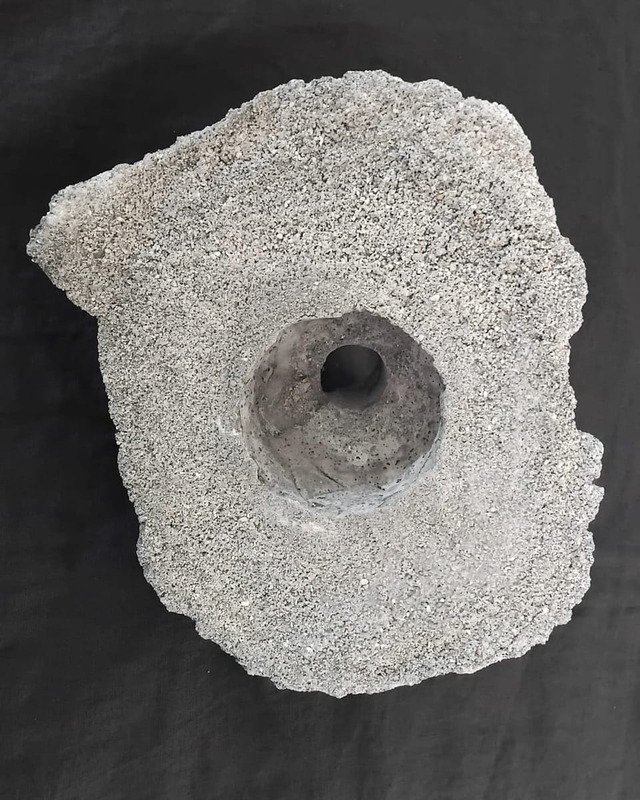
Removal had been planned. Planning was not release.
Oil applied before anything dried settled the casting, which sounds like a workshop detail and is in fact the whole argument. Intended absence can still fail, because a void answers to material rather than to intention, and the difference only shows once something has cured around it. Styrofoam blocks went in on the same principle, cut to the exact dimensions of lighting already chosen, so each recess existed as a specification before any stone existed at all. Both were placed in order to be taken out again.
Consequence of the tube extends well past casting. Cutting back into a stone afterwards is possible, and the stone always says so. Adding a component late is possible, and the composition always says so. Taking something out again is the operation no material forgives, which puts an unfamiliar order on any project: form of the absence first, exit route second, and only afterwards whatever will surround it.
Windows That Close
Lace confirmed the same casting law at one millimetre, away from concrete entirely, and added a second property to it. Mats are negative forms too, shallower and far less forgiving, and what they hold is a gesture rather than a mass.
Icy blue circles came off the mat intact and stayed flexible, bending without creasing, ready to be folded along the rim of a deep red elixir so half sits outside the glass and half within. One circle waited too long between the mat and the glass and split at the fold. Remaining circles went on perfectly that evening and stayed pliable.
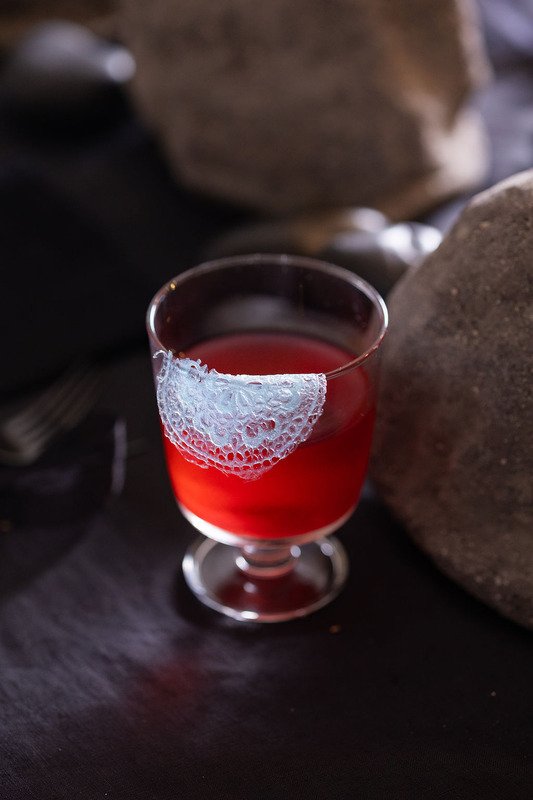
Blue came out of a pot before it came out of a mat. Butterfly pea flowers were steeped until the liquid ran deep, then went into the lace mixture while still warm, which produced a colour closer to sea crystal than to anything poured from a bottle. Plants offer a narrower range than pigment and a more convincing one, since a blue arrived at by infusion carries traces of whatever made it, and casting it thin keeps the depth. Depth is what steeped flowers give. Frost was what the piece required, so the infusion went back through trial after trial, cut and adjusted until the blue sat pale enough to read as ice instead of as ink. Preference decided nothing; testing decided everything. Colour reached by taking away rather than by adding follows the same law as the casting itself.
Nobody at the table identifies a flower. Everybody reads the sea.
Reading that as a failure of material would be a mistake. Neither the lace nor the mat had done anything other than intended. Identified instead was a window, since a shape released from any mould stays workable for a period and not beyond it.
Emptiness, in other words, runs on a schedule. Openings of that kind hold briefly, then close, and the moment of closing rarely appears in anyone's plan. Since that evening it appears in mine, written beside the tolerances as another number the material dictates.
Three questions therefore precede every casting here. Form of the void, first. Route by which it leaves, second. Duration for which it stays workable, third. Answering those three is cheap at the drawing stage and impossible later, and any studio or architect can run them against work that has nothing to do with sugar.
Behaviour Before Flavour
Grey arrived in three buckets, each mixed by hand, none of them a stock colour. Pigment took a pale base down by three different degrees, and all three went into the mould alternately, worked together where they met. Effort of that kind exists to become invisible. Rock reads as rock when no transition announces itself, and any tone that can be seen arriving has already failed.
Material library is indexed by behaviour before flavour, which is unusual in food design and unavoidable once casting enters the process. Cocoa butter tempered to 31.5 degrees, isomalt pulled at 165, lace dried until it bends without creasing. Cast stone keeps a column of its own: water ratio, pigment load, release treatment, and the hour at which a placeholder comes out cleanly.
Aroma bridges live in the same document, verbena to green almond, sea fennel to cucumber, toasted hazelnut to browned butter, each pairing tested for whether it survives cold, distance and the hours between casting and arrival. Tolerances are written down, since three millimetres of lace arrives intact and two arrives as dust. Numbers travel better than adjectives when a house asks what is possible.
Four Metres Decides
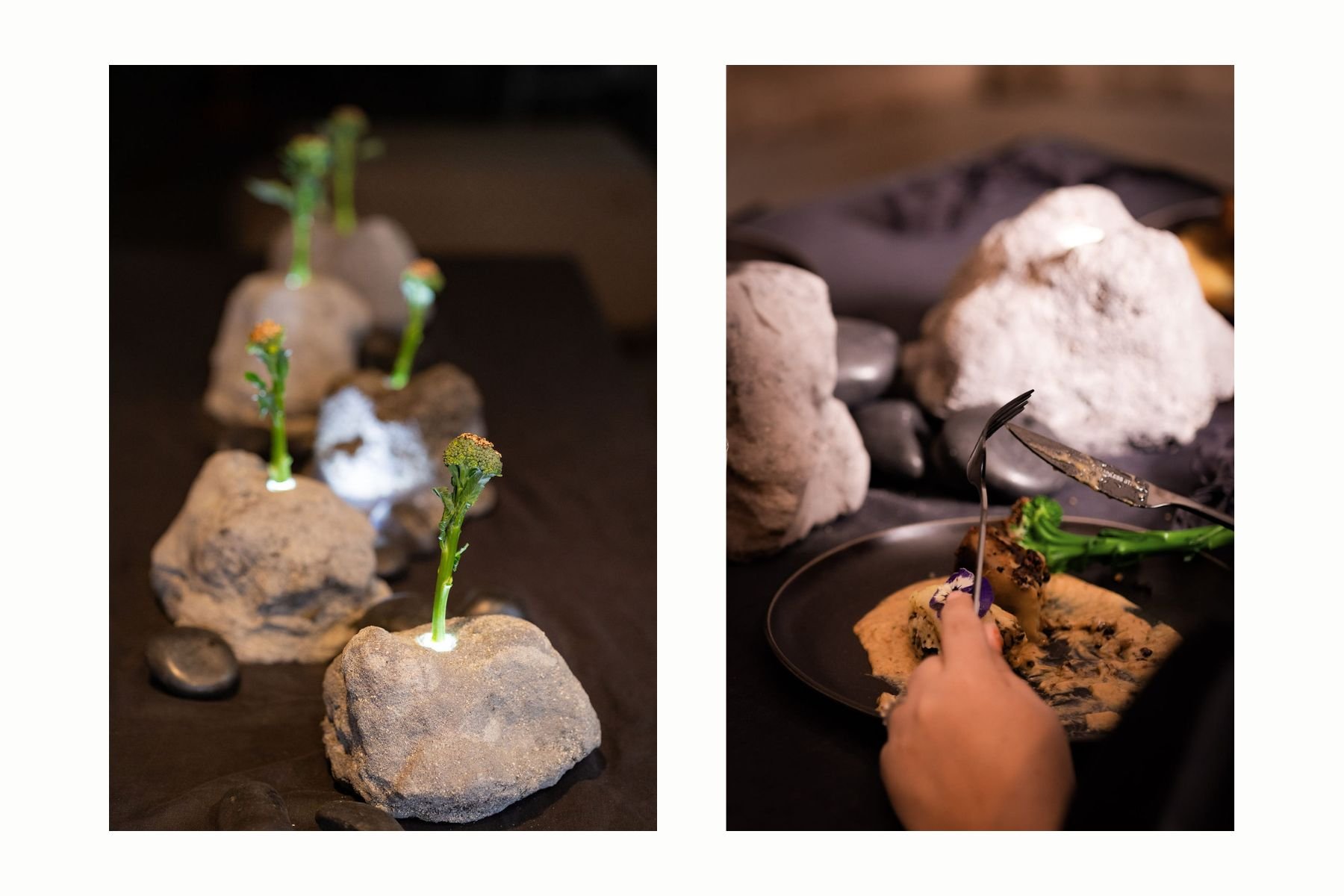
Rooms obey the identical order once casting logic leaves the bench. Broccolini rising out of a vessel reads as a silhouette at four metres and as texture at arm's length, and judgement forms at the first distance rather than the second.
LED sits buried in the body of the stone, so the surface holds light instead of receiving it. Placeholders went into the sand precisely because broccolini had to be lit from below, and every recess carries the fixture's dimensions because lighting was settled before concrete was mixed. Illumination from underneath makes a stalk read as though it were growing rather than arranged, which no lamp positioned elsewhere in a room achieves. Black linen underneath, river stones nearby, ceiling height, the angle at which a visitor first meets the table, all of it precedes any pour. Architecture briefs the casting, never the reverse.
Algae is what broccolini was meant to become at that range, clinging to rock where a tide has just withdrawn. Resemblance was the brief, and every casting decision served it: upright rather than flat, stone rather than porcelain, light from below rather than across. Produce arranged to look like itself rarely holds a room, while produce arranged to look like something older tends to.
Picking was the point. Seasoned in the kitchen and set upright in stone, each stalk waited to be taken by hand and carried to a plate, so the piece emptied itself over the course of an evening. Emptying was written in from the beginning, since a casting built to be stripped needs a different wall, a different height and a different weight than one built to hold. Hands reaching into a stone change what the stone is. Sculpture that expects to be dismantled behaves more like an invitation than like an object.
Perception works the same way at every scale. Nothing becomes visible until something else has been removed, which is why a crowded table reads as noise and a single lit object reads as a claim. Whatever is missing carries the composition, while presence merely occupies it. Designers accept that sentence readily and then plan in the opposite direction anyway.
Cost of Working Backwards
Plates are composed. Castings are decided. Practice of that kind meets casting at exactly that point, since a piece has to be correct before it exists and therefore has to be understood before it is made. Two vocabularies collapse into one under casting, because a vessel and an edible circle are then held to identical questions about wall, edge, release and window.
Considerable amounts of contemporary work run the casting sequence backwards, beginning with an ingredient and hoping a shape will emerge from it. Results are recognisable, since a shape arrived at that way tends to look arrived at.
Weeks pass before any casting exists, a bed of sand yields exactly one attempt, and improvisation on site is unavailable at any price. Efficiency has never been an argument for casting anything. Constraints of that kind sound like limitations and function as guarantees, since a casting understood weeks in advance behaves predictably in a room full of people.
Briefing conversations change character accordingly. Questions arrive earlier and sound more like architecture than like menus: ceiling height, first sight line, how long a piece needs to hold, whether anything is meant to disappear. Answers given at that stage are cheap, and the same answers given later are not available at any price.
What Is Taken Away
Frames get taken while a casting is still damp. Empty forms carry more information than filled ones, and an impression holding its edge says more about a casting than any completed vessel manages afterwards.
Moulds outlive whatever comes out of them, while a bed of sand survives nothing at all, which is the price of singularity and the reason a casting has to be worth what it destroys. Method held long enough turns into a signature rather than a style.
Photographs exist in a pair from that evening. First frame holds the stalks upright in stone. Second was taken later, stone standing empty behind a plate somebody had already been eating from, a stalk lying across it without ceremony. Order has left the second frame entirely, which is why it shows the finished casting rather than the first one does. Vanitas painters worked the identical interval, and nobody has ever accused a half-cleared table of being untidy in oil. Designing for a full vessel and designing for an empty one are two different briefs, and only one of them was ever the brief here.
Every object in a room is the shape of something taken away in time, and food design has fewer excuses than most disciplines for forgetting it. Accepting that leaves an unresolved question rather than a conclusion, since a piece designed to disappear raises the possibility that the object was never the design at all, only the conditions under which its absence becomes noticeable.
“Every object in a room is the shape of something taken away in time.”
Terms on which a commission proceeds follow from the same order of operations.