
CONTINUUM No. 002
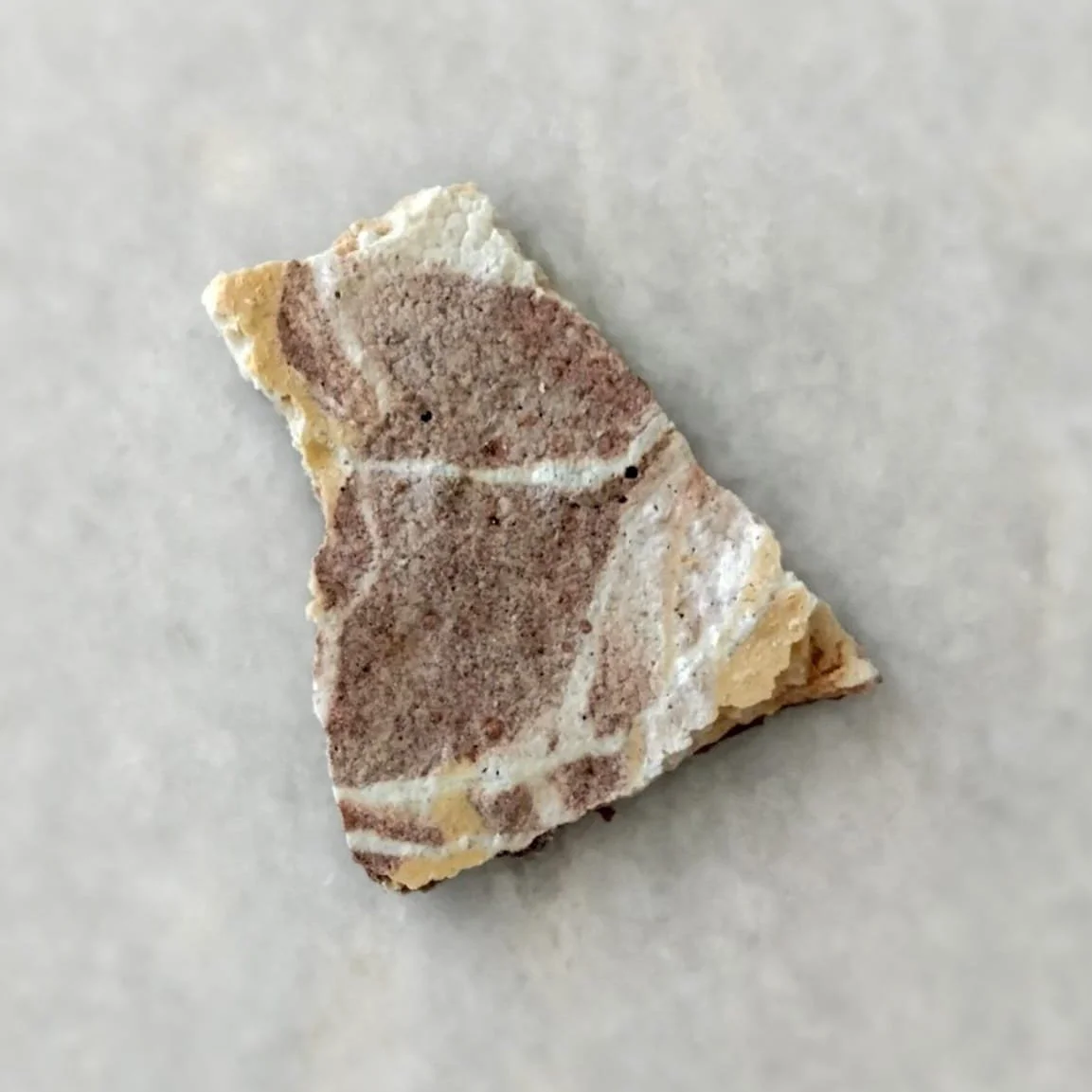
Porous Marble Invitation · Meringue, cacao, liquorice · Sent as edition.
Within contemporary art, edible sculptures occupy a territory that neither gastronomy nor sculpture fully claims. Objects made in this discipline hold form like stone, ceramic, or glass, yet dissolve into aroma and flavour the moment they meet the mouth. Permanence is exchanged for intensity. All edible sculptures carry their own ending inside them, and that ending is the point.
Deception operates as the founding method. Expectation arrives before taste ever does: form promises one category, material delivers another. Between promise and delivery opens a gap, and inside that gap, sensory perception becomes visible to itself. Most eating happens on autopilot. Interrupting that reflex is what edible sculptures exist to do.
Historically, sugar architects of the baroque courts built entire cities for a single banquet, and Japanese wagashi masters still compress a season into one small form. Neither tradition spoke of edible sculptures, yet both understood the medium's double life: admired first, consumed second. Contemporary practice inherits that duality and pushes it toward the perceptual. Trompe l'oeil, once a painter's game, becomes something the body verifies with its own senses.
Performance one unfolds as a landscape. On a wine barrel rests a terrain of plaster, folded and ridged like weathered rock, a single tap emerging at its base as though the formation had been quietly plumbed. Islands of icing sugar drift across the ridges like late snow. From these slopes grow white meringue mushrooms, caps dusted with cacao, edible sculptures made to be picked by hand. Behind everything, a wall of stacked stone and deep green branches closes the scene like a forest at dusk. Fungi are a calculated provocation: nothing signals danger more strongly than an unknown mushroom, and nothing rewards courage more sweetly than meringue.
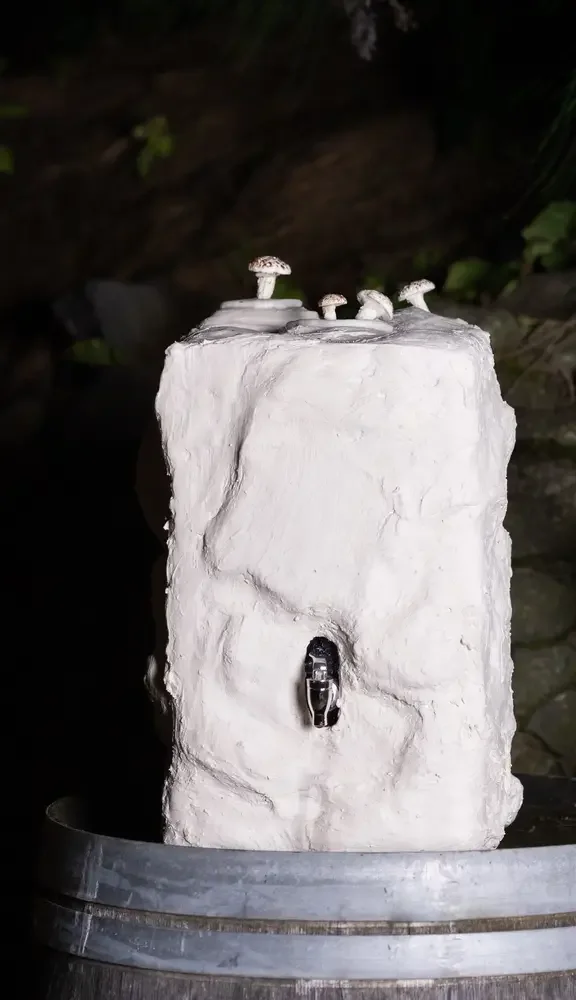
Meringue Fungi on Plaster Terrain · Meringue, cacao, icing sugar · Picked by hand
Marble carried the second act. Meringue, folded until its surface opens into a porous mineral grain, moves through the full register of the quarry: white into beige, grey into brown, cacao into liquorice. Nothing about it suggests pastry; everything suggests geology left out in the weather. Sent inside a box as one of several edible invitations, the piece precedes anything it announces. Recipients lift a lid expecting cardstock and find stone instead. Weight betrays it first. Resting on the stone, a chocolate coin pressed with an Egyptian motif and finished in edible silver leaf carries raspberry and pink peppercorn. Invitation becomes the first course of something that has not yet begun.
Both performances speak the same material language. Whipped protein and sugar, air folded into structure, behaves in the studio the way stone behaves in a mason's yard: it takes grain, holds edges, weathers into matte. One material, two deceptions: as an artefact, it impersonates a quarried mineral, as a landscape, it impersonates a living fungus. Range, in this series, comes from the lie, not from the pantry.
Rigour keeps either lie intact. Densities are tuned until resistance under the fingers feels plausible, cacao settles as patina rather than flavouring, and icing sugar reads as sediment instead of decoration. Approximation would soften edible sculptures into novelty. Exactness sharpens them into perceptual instruments.
Scale matters less than fidelity. Presentation follows two opposing logics: the marble piece obeys the vitrine, single, lit, unexplained, while the landscape obeys the forage, plural, shadowed, waiting for hands. Picking replaces plating. Participation in that exchange, turns every hand into the final tool of edible sculptures.
Language struggles with objects like these, which are part of their value. Words such as dessert, centrepiece, or amuse-bouche arrive pre-loaded with expectations the work refuses. Naming them edible sculptures keeps judgment open: audiences meet each object as art first and decide afterwards what eating it meant.
Landscape and artefact mark the poles of the series: one deceives through ecology, the other through impossibility. Together, they place edible sculptures at the centre of contemporary food design, where appearance, material, and meaning are composed as deliberately as any building.
Sensory Perception as Material
Materials carry the second half of the argument. Colour follows a rule of chromatic honesty: meringue is naturally white, cacao naturally umber, liquorice naturally near black, so every tone across both works, beige through brown into that deep mineral dark, belongs to the material itself and never to dye. Raspberry brightens the coin where the eye expected only mineral; cacao brings forest-floor bitterness where the eye expected soil. Flavour, in other words, completes deceptions the surface begins.
Humidity belongs to the material vocabulary as much as colour. Air moisture decides how long a meringue surface stays mineral before it turns soft, so timing becomes a sculptural decision: edible sculptures are finished not when they leave the studio but in the narrow window when structure and atmosphere agree. Hours, in this practice, behave like millimetres.
Research behind these edible sculptures runs deeper than any single object. Hundreds of botanical materials are catalogued in the studio by colour, season, structure, and aroma, so every composition begins as a search through that library rather than a guess. Pairings follow aroma bridges: raspberry meets pink peppercorn through shared floral heat, cacao meets sugar through shared roasted sweetness. Chance plays no part. Precision of flavour deserves the same rigour as precision of form.
Still life is the nearer relative. Painters of the Dutch Golden Age understood that a laid table could hold an entire theory of time and appetite. Edible sculptures continue that lineage with one decisive difference: the object ends inside the viewer. Vanitas logic survives intact: beauty, briefly held, then gone. Consumption completes the piece, and sensory perception is the medium through which completion happens.
Placement inside a room completes the equation. Light decides whether plaster reads as rock or prop; distance decides when doubt begins. Stacked stone and evergreen branches compress the scene into chiaroscuro; brightness belongs to contrast alone, never to added light. Installations built around edible sculptures choreograph the approach, letting discovery happen at a controlled pace rather than all at once. Architecture, in that sense, is the final ingredient of every piece.
Photography holds what consumption erases. Records of process, from the first fold of meringue to the sealed invitation box, stay in the studio archive as proof that the object existed at all. Related works surface across the Archive and among Selected Works, each entry holding only what the piece requires. Documentation, decided piece by piece, remains confidential by default.
Development continues. Further works will test silicone castings taken from real objects, forms with no culinary reference at all, where the discovery of edibility arrives as pure surprise. Each of these edible sculptures answers to the same standard: form must mislead perfectly, and flavour must reward the misdirection.
Commissions built on this territory begin with a conversation about one specific space.