
NO. 05 · STRUCTURAL STACKING
Food Architecture
Monument scaled to the palm, handed over as a greeting.
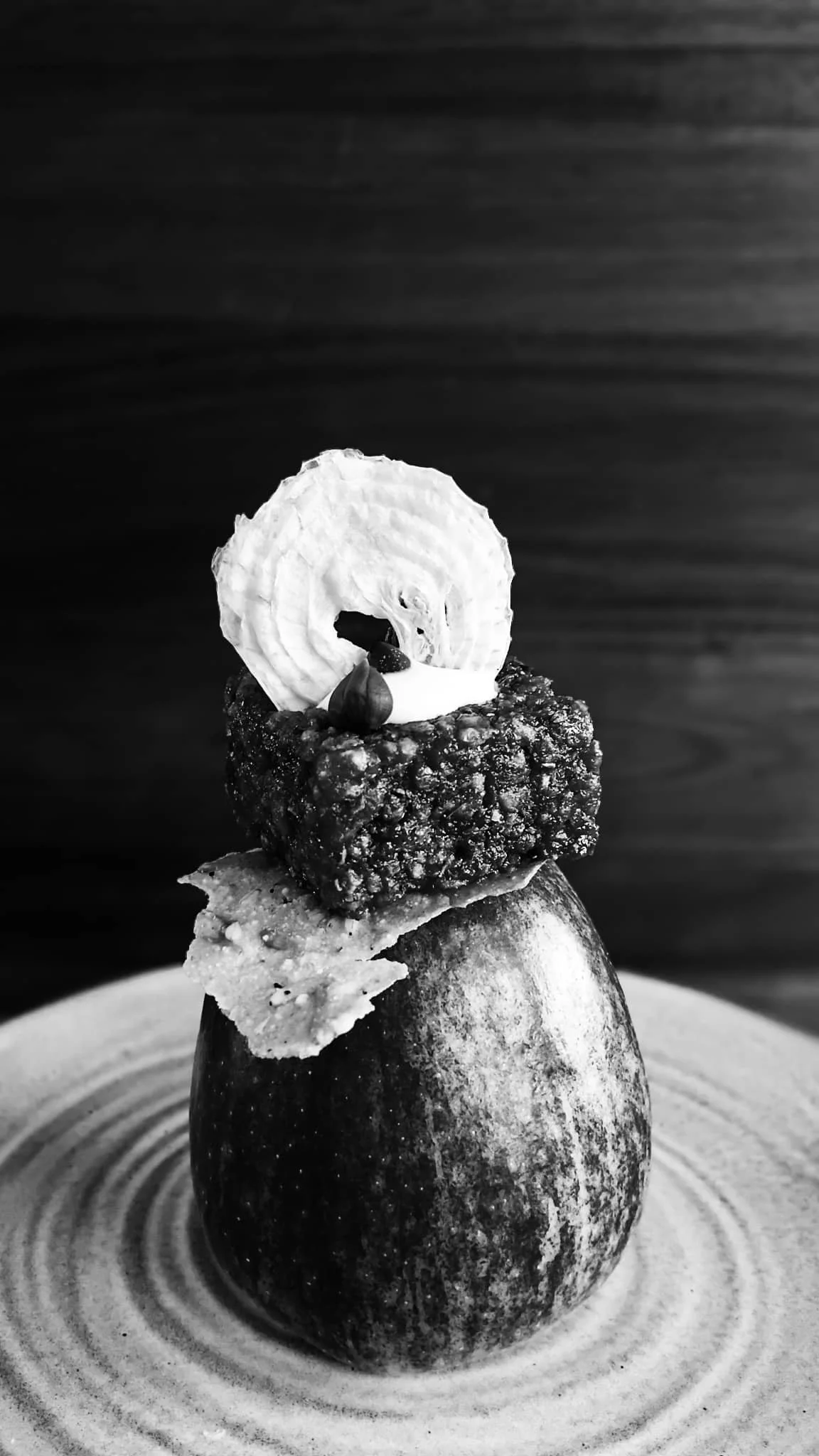
At a first meeting, Veceto hands over food architecture in place of a greeting. Nothing is said about it at the moment of giving, and no conversation has yet found its subject. It is meant for its recipient alone, the owner of the lodge. Upright and finished, the piece asks to be taken up at once. Height and poise say what a sentence could only approximate. Whoever holds it decides how long it remains whole; that choice is left entirely to them. Introductions usually travel by word. Kerstin Pricken lets this one travel by weight, by scale and by the care visible in every level.
I · MEETING
Underneath sits the opening decision: no ordinary plate. She wanted a ground that could itself be eaten. So the lowest layer carries everything above, and belongs to flavour as much as to structure. From there the stack rises by stages, each resting on one able to bear it. Culinary architects would begin the same way, with load ahead of ornament. Ambition is fixed from the outset and never revised along the way. Instead of a small dish, the aim is a monument. Scaled to the palm, it becomes exactly that: a building one can lift. Spatial composition is what food architecture becomes at this size, a matter of thresholds. How far may a column climb until the eye stops seeing a bite and starts seeing a tower? Growth ends where balance ends, and no further layer is added once the whole holds.
II · FOUNDATION
Black and white is chosen for the record. Colour would pull the eye toward every ingredient and away from the order in which they were assembled. In monochrome the parts recede, and the build stays legible. Inside Veceto’s food design studio, an image is made to keep the form, since the original is not meant to last. Tone is set so that food architecture registers as construction, and only afterwards as flavour. Seen from across a room, the piece appears as a silhouette; brought close, it resolves into a sequence of choices. Behind the image lies a quieter form of edible scenography. Everything is made in the studio, down to the cracker and the dried onion. Just the apple and the capers are bought. Precision belongs to the joins: where each level is set, and how squarely it rests on the last.
III · MONOCHROME
Receiving it means deciding when it is over. Its recipient is also the one to finish it, and no audience is invited to watch the monument come down. Among the edible art creations kept in the Archive, food architecture of this kind is private by nature. Conceived for that meeting alone, it is never placed before a room. Closest in spirit is eating design, where the same bite is read twice against different grounds. Structural Stacking is taken in once, closely, by a single person, at the pace of an introduction. Afterwards nothing stands upright. What remains between people who have just met is a taste held in common. With it stays the memory of a structure that was briefly theirs.
Each commission is drawn from the house that asks for it, and belongs to no other.