
CONTINUUM No. 005
Openings Placed on Purpose
Avant-garde fashion designers treat an opening in cloth as a decision. Taylor placed several at Somni this August. Veceto came already asking a version of the same question, in a different material entirely. New Zealand Fashion Week 2026 offered two rooms to pursue it in, four days apart. Negative space design ran through both: cloth cut with intent in either room, the same discipline Veceto asks of bread. Pieces by Taylor, Anthurium, and Marmalade Hats carried that argument through Somni's runway first. Another room, quieter and further from any stage, carried it again on entirely different terms. Both rooms left Veceto asking the same question: how much can be removed before a shape stops holding.
Fashion Week's Negative Space Design
Negative space design surfaced more than once at Taylor's Somni show, carried by pieces built to hold it on their own terms, look after look. Veceto reads a precise term into what they share: the practice of removing material on purpose, its remaining structure built to carry its own shape. Familiar and strange at once. One form always becoming another. Closing the distance between idea and garment, as avant-garde fashion designers so often do, cutting away became the method itself in all of them. Not a finishing touch, applied once the garment already existed.
Naming the Method
Seams turn into hinges where removal interrupts fabric instead of building it up. Gaps turn into the point being made. Deconstruction exposes a structure that was already there. It goes further, removing part of that structure and daring the remainder to carry its own weight. Avant-garde fashion designers reach for this vocabulary of cut often. Within this collection, several garments returned to it, each in its own way.
Garment construction earns a precise name here. Somewhere between deconstruction and restraint it sits, closer to a métier than to a trend. Not fabric left unfinished, not fabric withheld for its own sake, but fabric removed with a specific outcome already decided. Avant-garde fashion designers working this discipline plan the opening before they plan the seam around it, exacting and intuitive in the same breath. Printed on the card at the door, the dreamscape set the tone from first look to last.
At Somni, runway and room formed a single composition. Schedule, setting and finished looks worked as parts of a whole. Avant-garde fashion designers who build a couture show around this kind of absence rarely stop at the garments themselves. Its premise extended into lighting and pacing, down to how looks moved past the audience.
Intention named first changes how whatever follows gets read. That show set the principle early, letting every piece answer to it afterwards. Something similar holds in a different practice too, where naming a premise before anything is tasted changes how closely what follows gets noticed.
What the Night Removed
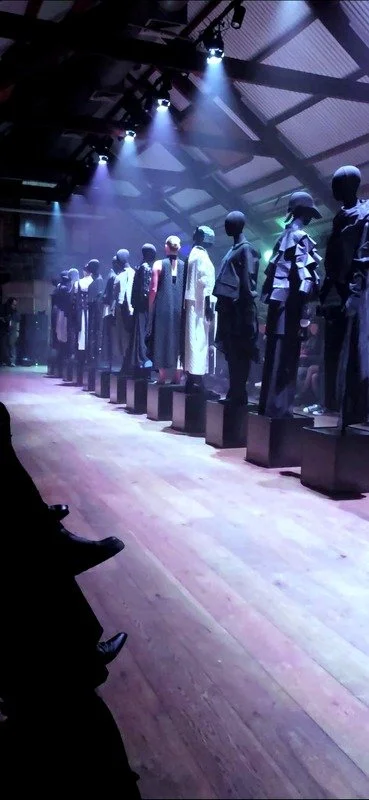
Somni, New Zealand Fashion Week 2026. Veceto.
Darkness held the room first. Pedestals gathered at its centre, mannequins standing among people, impossible to tell apart until a shift of weight gave it away. Models stepped down to circle them in rhythm with the music, then climbed back up to stand again, still, exactly as before.
Cut into a lace of small openings, a black shawl crossed the shoulders, worn over the white Specify Shirt, its two cuffs closed in black, paired that night with matching trousers. Worked as a stencil, the shawl let the shirt beneath show through at every gap. One layer rarely does this much work twice. Cover, once. Exposure, once, through the very thing doing the covering.
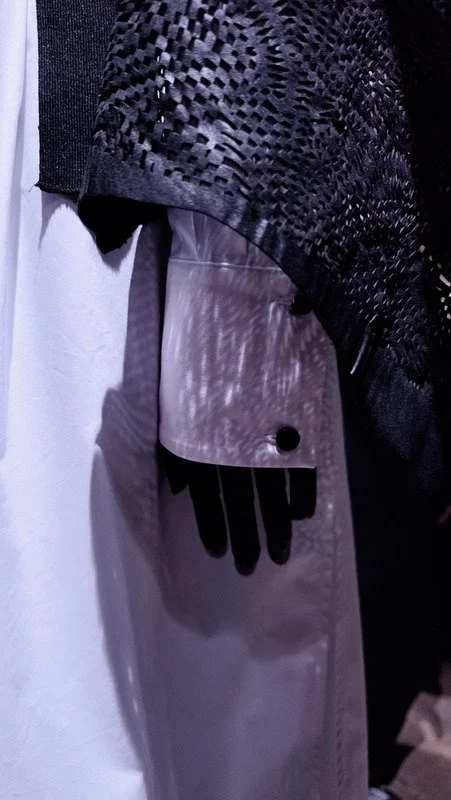
Shawl and Specify Shirt by Taylor. Veceto.
That night, negative space design pushed further into a second look. Worn together with a white cord necklace at the throat, a white jacket and matching white skirt carried a perforated texture across both pieces. Small, deliberate openings crossed both pieces in a grid. Their names are the Barter Jacket and the Location Skirt. Taylor Boutique, which Vicki founded, carried that argument in fabric. Veceto carries an identical argument in bread and aioli. Both ask a surface to announce what has been taken from it, instead of disguising the gap.
Named the 3/4 Chain Mask by Chloe Giles, who leads Anthurium, it carried its own negative space argument in a single decision: chainwork usually worn low on the hip, remade here as a single piece for the head instead. Each link still catches the light the way it would at the waist, only now framing a face instead of a stride. Anthurium works from adornment as an extension of the self, a question first asked through performance before it reached chain. Her chainwork treats the head the way avant-garde fashion designers treat a torso: a surface worth interrupting on purpose.
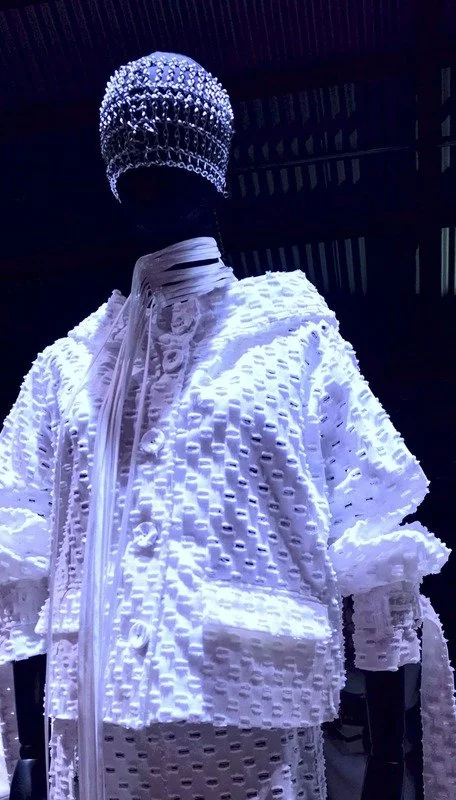
Barter Jacket and Location Skirt by Taylor, worn with a 3/4 Chain Mask by Anthurium. Veceto.
Construction carried the premise further in another piece. Named the Sequence Jacket, it layers a second fabric beneath the first. Marmalade Hats completed the look with a wide-brimmed piece. Avant-garde fashion designers use exactly this kind of construction to keep a collection legible long after it leaves the room it was built for.
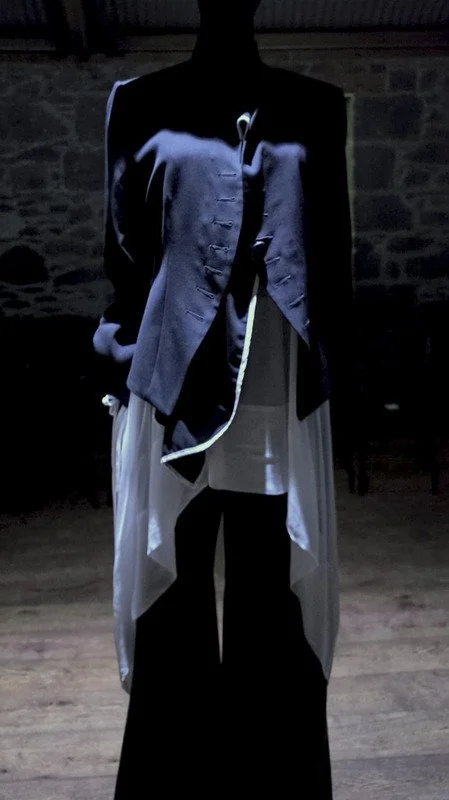
Sequence Jacket by Taylor. Veceto.
Somni took its name from the space between sleeping and waking, where the familiar turns strange without warning, a line needing no translation, only recognition. At its sharpest, this approach asks a viewer to notice a gap before they notice what used to occupy it.
Deconstruction and the cut stand close together, with different aims. Exposure belongs to deconstruction: a seam left raw, a lining visible, process legible on the outside of a finished piece. Removal belongs to the cut, letting what remains carry a silhouette that once depended on what just left it.
What the Morning Kept
Days later, Fashion Week gathered a quieter room on terms just as telling, different from the runway's pace. Everything within reach, New Zealand design and international labels sharing the room as equals. Proximity governed The Shelter throughout the morning. Newer names stood close enough to speak about their own work directly, and a question-and-answer round carried the entire program. Conversation formed part of the format by design.
One skirt carried its own negative space design argument into this quieter room too. Cut from black fabric with a triangular white panel set into one side, its name is the Fixture Skirt. Shown on the runway as well, it was photographed in the store, away from stage lighting. That decision held first in fabric. Remove a wedge of the dominant colour. Replace it with its opposite. Let the join itself carry the statement, instead of a print or an embellishment added on top. Its asymmetric hemline let the skirt hold its own sculptural volume even standing still. Away from runway lighting, the skirt asked for a slower kind of looking. Nothing about the panel announced itself from across the room. Standing close, the seam read as deliberate within a few seconds, the two colours meeting at an angle of complete precision.
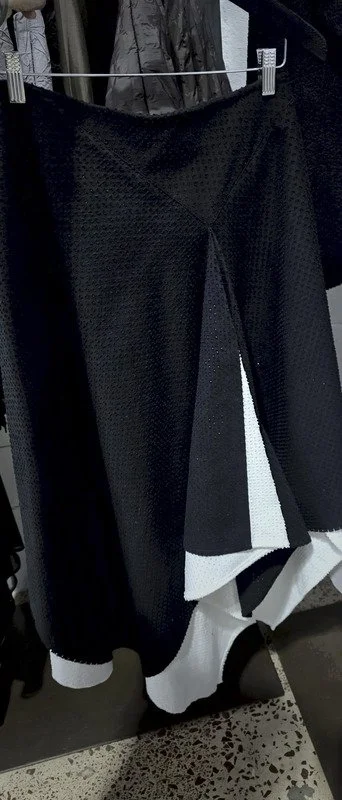
Fixture Skirt by Taylor, photographed in store. Veceto.
Elsewhere in the room, avant-garde fashion designers worked the same instinct differently, a reminder that this kind of absence belonged to no single label that week. 132 5. ISSEY MIYAKE showed a windowpane check, its own argument made in grid lines rather than in a cut panel. Nearby, a blouse carried blossoms sewn on like ruffles, ornament worked into the line of the garment.
Two Disciplines, One Cut
Veceto reads this architecture of absence as food and fashion in deliberate conversation, two disciplines solving one equation in different materials. Cutting a gap into cloth and cutting a gap into a dish depend on identical discipline. Decide, before anything gets removed, exactly how much can go before the remaining structure fails outright. That same calculation runs through this particular practice: how much a structure can still carry after losing part of itself. Runway collections show it season after season, evidence that outlasts the room it was made in. Veceto carries the same atelier discipline into bread, judged by eye and by hand. One comparison carried out of that week on its own: silk's particular sheen finds its closest answer in agar, read for the same quality rather than the same origin.
Diminuendo sets that discipline into bread. Five wreaths, each nineteen centimetres across, stack evenly to a height of seventeen centimetres around a bowl set flush into the top ring, its rim out of sight. Aioli itself carries the mark of a spoon lifted straight upward rather than dragged, a texture that records the exact moment it stopped being touched by hand. The Oceanic worked an identical premise once already. Lace there turned edible, read as structure rather than as trim. Absence must be designed before presence can be perceived at all. Diminuendo asks exactly how much bread a bowl can carry before its own shape stops being the point.
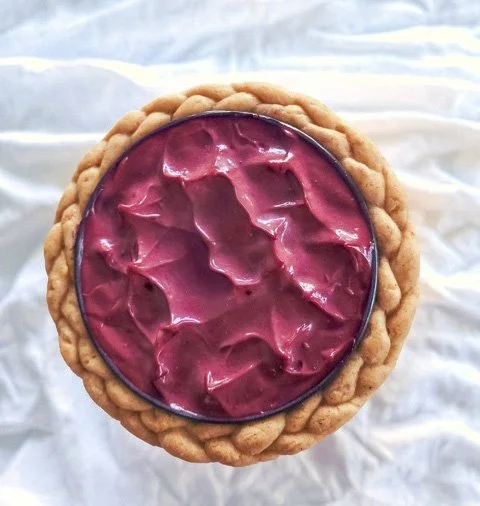
Diminuendo. Veceto.
Treated this way, cutting away stops being a technique borrowed from one discipline by another. Decision made with a blade instead of a needle counts as an identical act, whether the tool in hand belongs to a pattern cutter or to a food designer following the same instinct in another material. One difference still separates them. Cloth keeps its void exactly where the cut left it, looked at and worn long after the venue that first held it empties out. Diminuendo hands its own last removal to whoever eats it, witnessed once and never again the same way.
Two Rooms, Four Days Apart
Stage light asked the cut to read from a seat in the dark, as outline before detail. Morning light at The Shelter asked the same of it from a hand's width away, where a seam answers for itself. Across the room, an opening draws a silhouette; at arm's length, it shows the edge of the blade. What both rooms showed reads less like a shared trend than a shared constraint. Under it, avant-garde fashion designers and a food design studio work from opposite directions. Cut away with intent, place what remains with precision, and the absence itself becomes legible as intention, not accident. Food and fashion each brought half of the case, meeting on ground neither had chosen in advance.
Studying a photograph of the perforated jacket afterwards, Veceto looked for the point where the maker had decided exactly where to stop. That point rarely sits where a first glance expects it. Fabric keeps its decision in a seam, waiting for a second look. Bread keeps its decision in a texture, waiting for a thumb pressed against it. Both decisions survive being overlooked. Neither depends on an audience noticing to remain true.
Somni gave itself to the runway. At The Shelter, Saturday morning belonged to conversation, over coffee and close to the work. Veceto left both rooms with the same discipline seen in two materials: in cloth, an opening placed with intent; in bread, a form that completes itself as it is eaten.
· INDEPENDENTLY WRITTEN AND PUBLISHED.
· NO DESIGNER OR LABEL FEATURED HERE PAID FOR INCLUSION OR SPONSORED THIS PIECE.