
CONTINUUM No. 003
Most functional art is measured by how long it outlasts the hands that use it. Chairs earn their standing over decades of sitting, and bowls over thousands of ordinary days. Objects made for long lives are judged by their endurance. Work made for a single evening is judged by its ending. Endings can be designed as carefully as a joint or a seam. Veceto works from the opposite end of that scale. Within the practice of a food design studio, use does not wear a piece down. Use completes it.
For one evening of immersive installation art, cast stone stood in a darkened space. Something green rose from each piece. Every vessel was lit from within, and every stalk inside it was meant to be taken. Taking was the purpose, never the damage; the work was built to arrive at that point. Read this way, functional art keeps two clocks at once: one for what remains, one for what is eaten.
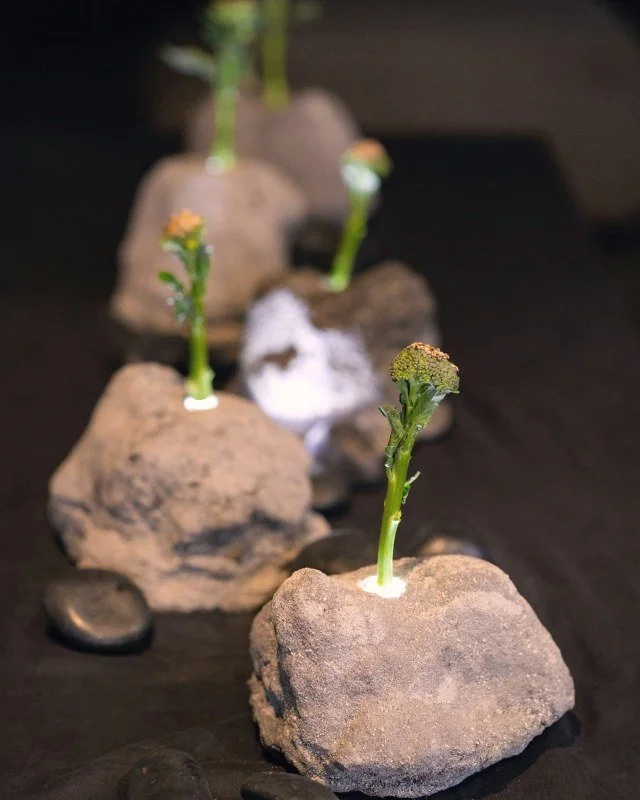
Lit from within, before the first is taken.
Completed by Use: Edible Objects
Inside the vessels, everything was made to leave. Broccolini, seasoned and set upright, waited to be taken one stalk at a time. Edible objects of this kind are not ornament resting on a support; theirs is the part of the work that finishes it. Few materials accept the condition edible objects carry: they are complete only when gone. Designing for that condition means deciding, in advance, the order in which a composition will disappear. Picking thinned the arrangement a little further each time, and every absence had been drawn in from the start.
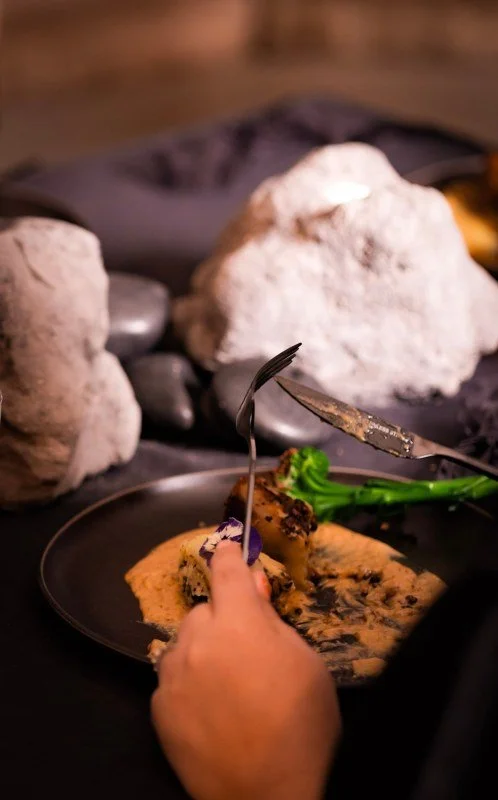
Taken, and the stone remains.
Beside the stone, a circle of edible lace rested at the rim of each glass. Steeped blue, it was folded so that half sat outside and half within. Colour came from flowers infused until the liquid ran deep, then cast thin enough to read as ice rather than ink. Lace and elixir belonged to the same hour. Neither was designed to outlast it, and neither needed to.
What Remains in the Stone
Vessels were cast in sand as an edition for this work, and for no catalogue. Damp sand takes an impression once and gives it back once, so no two pieces share a wall. Grey came from three buckets, each mixed by hand, none of them a stock colour. Worked together in the mould, the tones met without a seam. Rock reads as rock only when no transition announces itself.
Silicone would have allowed a run of identical forms and was declined for exactly that reason. Repetition belongs to the shelf; a casting of this kind belongs to the evening it was made for. Afterwards, the vessels remain. They are functional art in the older sense, objects that can stand again in another room, under another light, carrying something new. Their edition is small by design, and none of it was ever offered for sale.
Light Carried Inside the Body
Glass tube and light source went into the sand before any concrete was mixed, so each vessel carries its own illumination. Placeholders for every fixture were cut to the exact dimensions of the lighting chosen. Each recess existed as a specification before any stone existed at all. Lit from underneath, broccolini reads as growing rather than placed. No lamp positioned elsewhere achieves that effect. Light that rises from the object asks nothing of the architecture around it; ceiling, wall and window stay untouched. Seen from across the space, the vessels gave off no visible source, only a soft rise of brightness at each opening. Quiet of that kind is functional art at its most exact.
Dimming the space did the rest. With the overhead lamps lowered, attention moved to the stones themselves, and the green above them became the brightest thing in sight. Nobody needed to be told where to look.
Tolerances Kept in Writing
Behind every evening sits a material library, indexed by behaviour before flavour. Cocoa butter is tempered to 31.5 degrees; isomalt is pulled at 165. Three millimetres is the thickness at which lace travels intact, and that figure is written down beside the others. Concrete keeps a column of its own: water ratio, pigment load, release treatment. Its last entry is the hour at which a placeholder comes out cleanly. Numbers travel better than adjectives when a house asks what functional art can carry.
None of these figures appears in the finished piece. All of them decide it.
Low Tide in a Darkened Room
Among river stones on black linen, each vessel took its place as rock among rock. Crowned with green, the group recalled algae at low tide rather than anything set out. Sand grain, the pale lip of every opening and seasoning on the stalks belonged to that same shoreline. Stone, linen and cast grey kept to one register, and green was the only colour allowed above it. Surroundings stayed dark and plain, so the vessels could carry the glow alone. Ceiling height, the first sight line and the angle of approach were settled before any pour. Architecture briefed the casting, never the reverse, and functional art of this kind answers first to its room.
Two Times in One Work
Wear, in most crafts, is the slow adversary of the object, and patina is the truce between them. Veceto’s practice reverses those terms. Whatever is eaten completes the piece; whatever remains is ready to be lit again. One work, then, holds two durations: the life of an edition and the length of an evening. Both carry equal weight.
Planning an evening around disappearance changes the questions asked at the start. How long should a piece hold its shape, and in which order should it thin? Where should the eye land once the green has gone? Answers to those questions are drawn before anything is cast, in the same notebook that holds the tolerances. Disappearance, treated this way, stops being a loss and becomes a form with its own outline.
Late in the night, the stones stood empty and still glowing, each an outline of what had been taken. Empty, the space still looked complete. Functional art reaches its end in many ways, and few of them are as precise as being eaten.