
Elemental Ritual
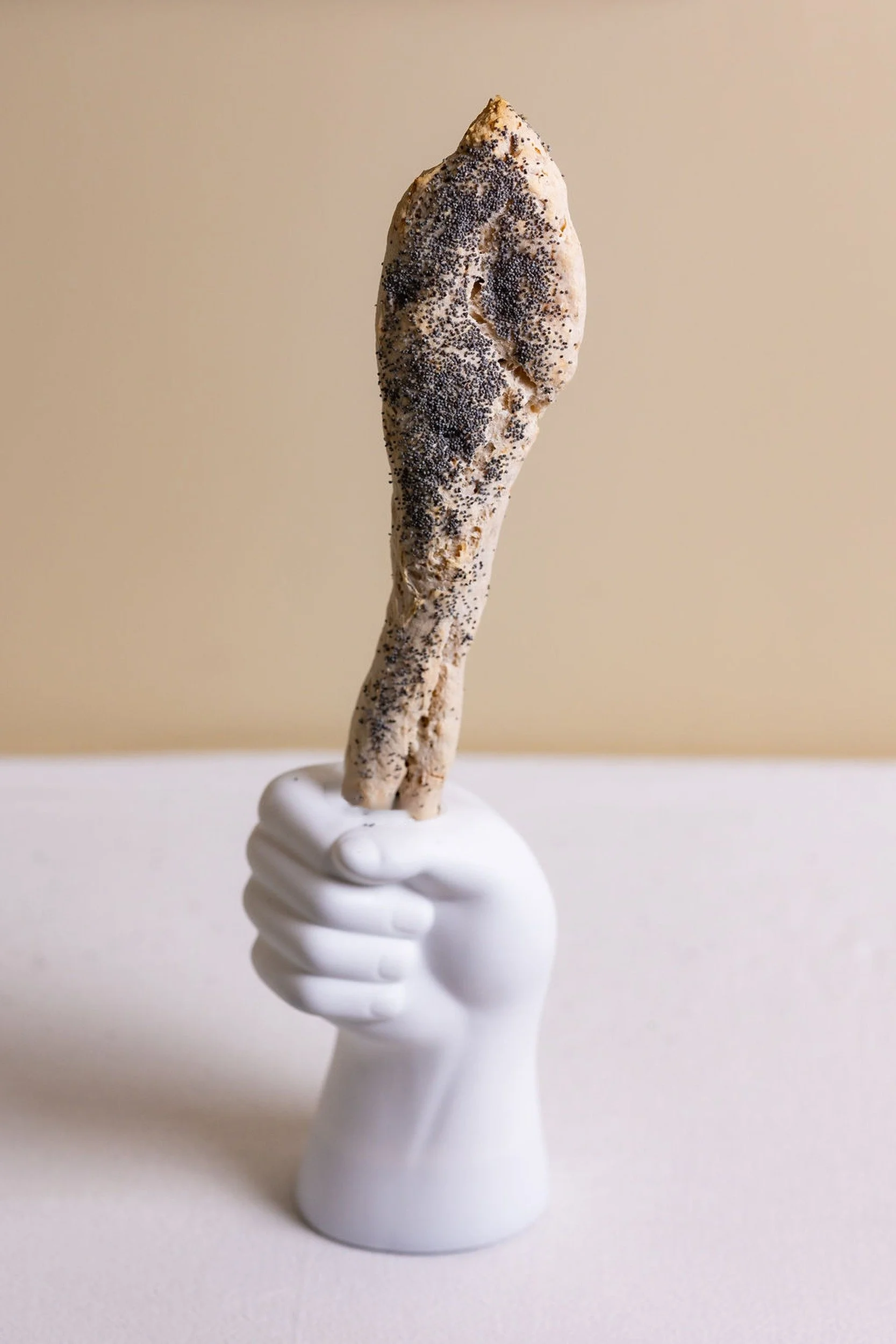
Food Performance Art
In Elemental Ritual, a work of food performance art, an old welcome of bread and salt gained what it has always lacked. Held low along the front, water arrived unpoured. Behind it, bread rose as sceptres, each gripped in ceramic. Between them stood a watering can, quiet at the centre. Authority and nourishment shared one arrangement, and nourishment decided how it ended. Almost nothing in the durational tableau was built to keep its form. Every broken tip carried the cycle one turn further, back toward the hands that had made it possible.
CLASSIFICATION: Durational Food Performance
LOCATION: Tauranga · Year: 2026
MEDIUM: Butter, bread, salt, oil, spirulina, ceramic
CONCEPT: Authority, measured in butter, bread and the time salt takes to dissolve.
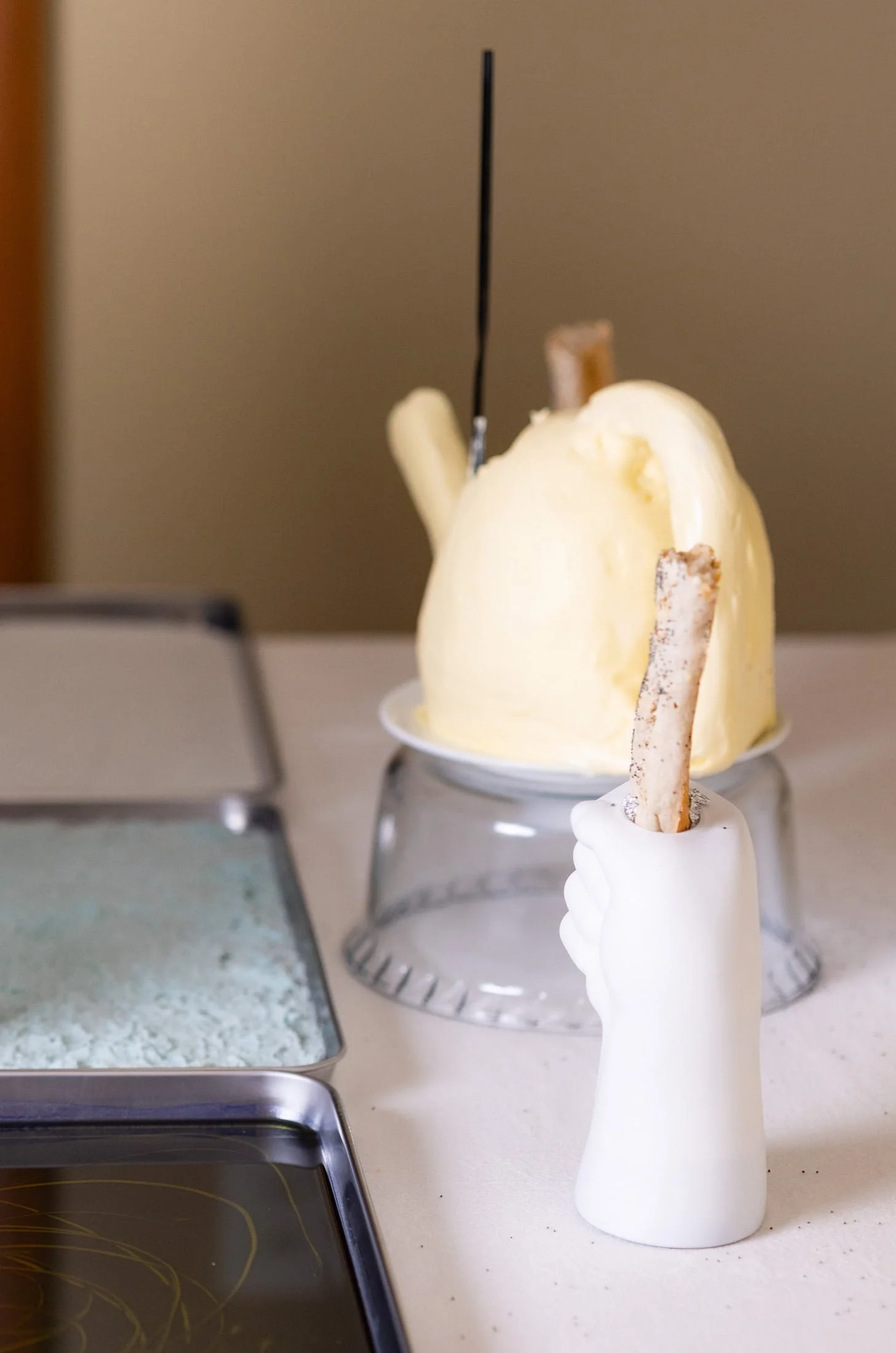
Bread and salt still open doors in many houses. Travellers back from long journeys have been greeted with them. Offered at a threshold, they stand for shelter and a share of what the house holds. Water, without which neither exists, has never been part of the gesture. One is what the sea leaves behind; the other is what rain makes possible in a field. Staged as food performance art, Elemental Ritual set that missing element first. Greeting gave way to cycle.
Everything began with a single decision: a loaf shaped as a sceptre and held by a hand. Next came blue, standing for water, and a vessel followed it, since nothing can be tended without one. Ornament had no place in conceptual food art built on that logic.
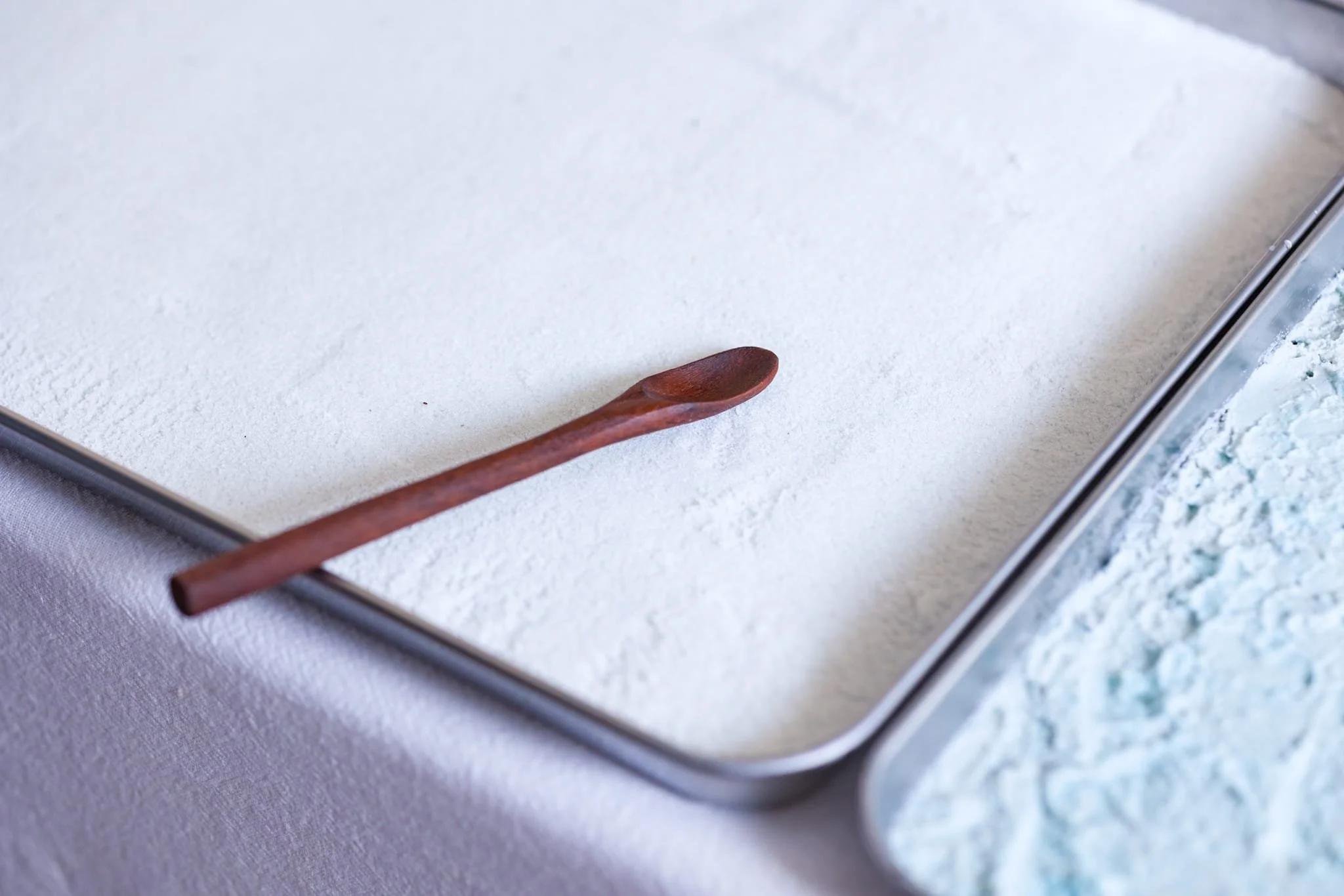
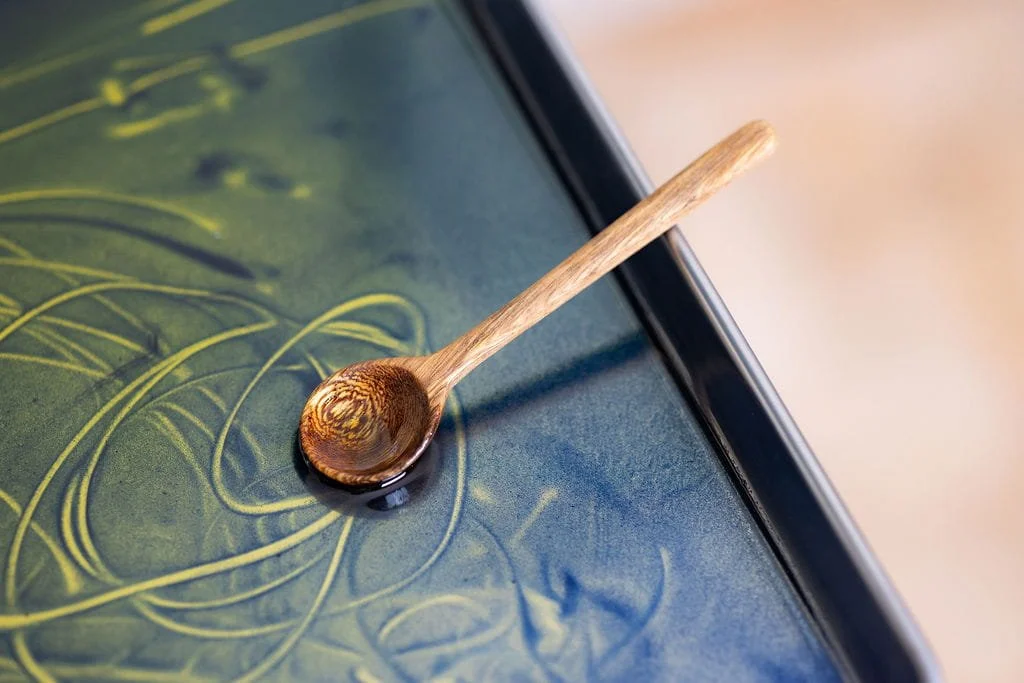
Trays were never meant to read as edible environments at first glance. Laid low and flat, their contents settled into planes of pigment, nearer to a monochrome painting than to anything prepared for eating. From afar they suggested a still pool; up close, something to taste. Texture returned only to those who leaned in: crystal beside matte, matte beside gloss. Recognition was delayed on purpose. Such restraint is a form of curated absence: only what may be taken asks to be noticed. Attention arrived by degrees, and the piece became immersive, unprompted. Appetite arrived second.
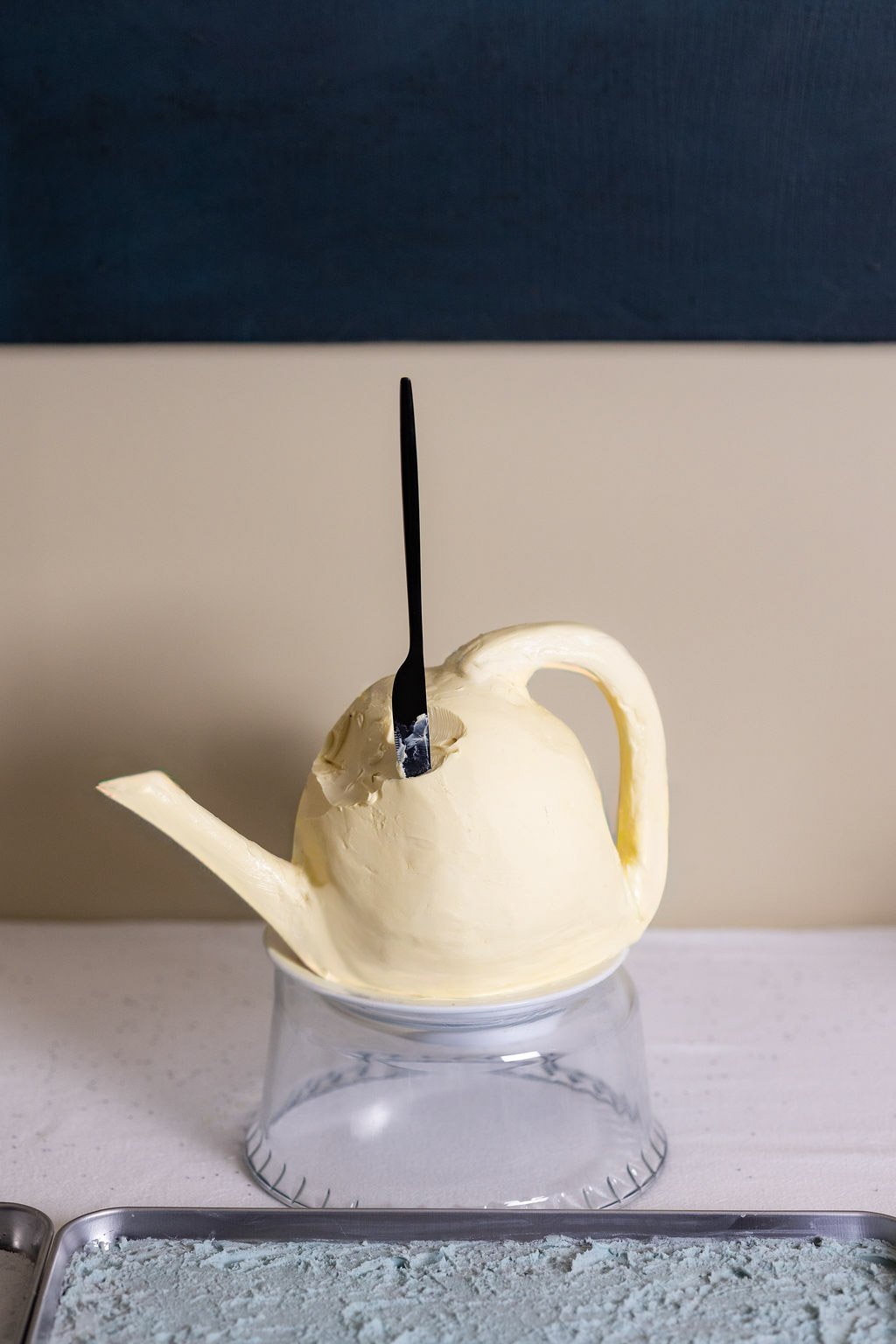
Where a throne might have stood, a watering can claimed the sovereign space. Pouring precedes every harvest, so that seed may sprout and, much later, be broken. Tending comes before any crown in that order. Care occupied the position that command usually reserves for itself.
Regalia survive because nobody is permitted to eat them. Orbs and crowns pass from reign to reign untouched. Loaves, by contrast, are made to be shared within a day. Grip mattered more than shape. Closed ceramic hands steadied each loaf without hiding it, firm enough to grip and loose enough to give. Fired clay outlasts almost anything made by hand. Given the lesser role, it carried what would not last. Lifted that high, crust and crumb turned into an emblem; broken, they became a gift again. Translated into food performance art, a sceptre could be eaten, and was.
Light entered from one side, through doors standing open, the threshold of the old rite left unguarded. Outside stayed present: air, daylight, the weather on which every ingredient depended. Approaching meant passing through the cycle in order. Pigment led, then the vessel that pours, then loaves lifted aloft. Arranged in a hemicycle, those hands resembled an assembly caught mid-vote, every arm up for the same motion. Unanimity lasted until a piece was taken. Spatial dramaturgy of this kind needs no caption; distance supplies the sequence.
Butter, Bread and Salt as Durational Tableau
Butter formed the watering can, an edible sculpture at the centre. Fat is usually trusted to store warmth. Elemental Ritual trusted butter to surrender it. Of the materials, it yielded most openly, so care, set in the middle, softened soonest.
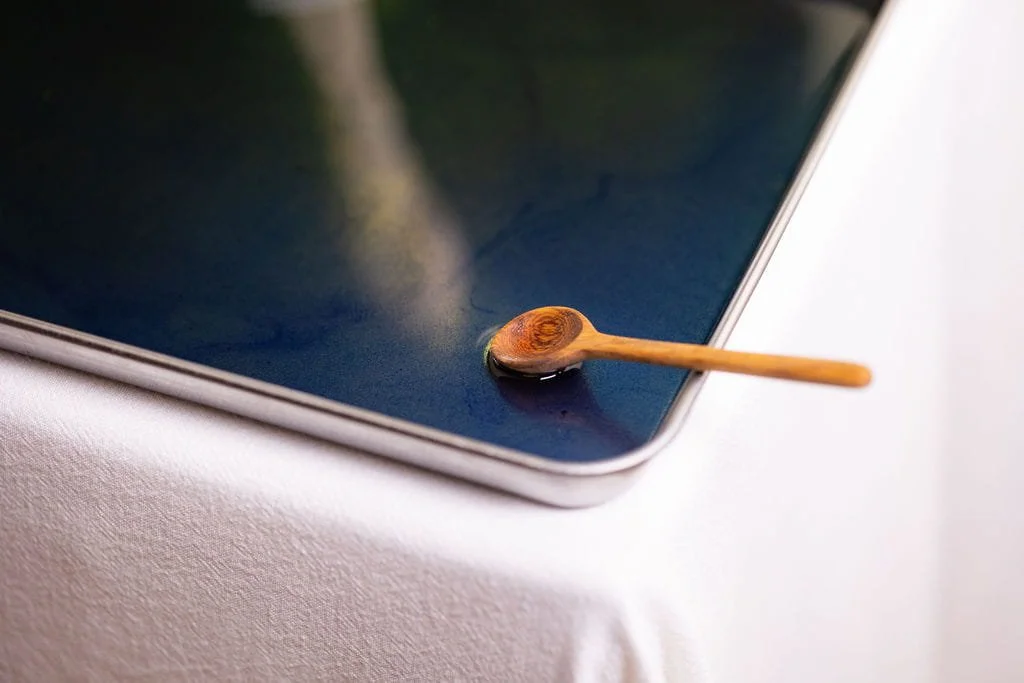
Salt was simmered in pea flower tea, then dried slowly over many hours until the blue drew inward and settled into crystal. Long traded as a measure of worth, it measured time instead. Dissolving takes as long as the air allows; no one decides it. Hours in the dehydrator remained the least visible part of the work. Pea flower turns violet at the slightest trace of acid; its blue survived only because nothing sour came near. Almond cream took its tint from spirulina. Oil tinted likewise lay over green olive oil, waiting. Side by side, cream and crystal suggested shallows of different depths. Testing preceded everything, for the butter sculpture and for the crystals alike. Edges in butter last only while the air stays cooler than skin. Raking light finds the first slackening of an edge long before any shape gives way.
Stillness held until a spoon entered the oil. Wherever someone reached in, the surface parted and green rose from beneath: a field under the water that feeds it. Spoons moved through it like brushes, so taking became a kind of painting. Sound, scent and hue arrived together, a multisensory moment before it was a visual one.
Mirrored on that surface, a ceramic hand floated beside a sceptre already missing its tip. Reflections cannot be eaten. Among all its parts, that hand alone lay beyond reach, and it vanished whenever a spoon touched the oil. Holding and losing shared one frame: a grip unable to let go, and bread already given away. People present did what ceramic never could. They let go.
Material transformation rarely looks like change while it happens. Followed this closely, it resembles evidence: something was there, and someone reached in. Each piece taken from an upright tip returned the loaf to what it had been before anyone shaped it. Ritual depends on gesture more than on belief, and its gestures stayed few: hold, offer, release. Repetition built a rhythm of its own, until the arrangement looked thinned, never preserved. Watered, raised, broken and shared, the sequence completed itself in other hands. Within food performance art, that subtraction is the record.
Softening was the point, never the risk. Permanence would have flattered the emblem; impermanence told the truth about it. Time, measured in this way, ran through the materials rather than across a clock face.
As food performance art, Elemental Ritual asked to be remembered rather than possessed. Photographs carry it forward now, each taken before it had finished its own disappearance. Site-specific by nature, this ephemeral spatial intervention belonged to that room, that light, those open doors. Veceto, a food design studio, kept only the account. Restaging it exactly would undo the premise. Its afterlife belongs to memory, which keeps colour longer than shape.